

Which Zoologist sample to try first
Zoologist names every perfume after an animal and gives each to a different perfumer. Eight samples in order of Parfumo ratings, and a map of the notes they share.

Zoologist names every perfume after an animal and gives each one to a different perfumer, whose name is printed on the box. Victor Wong founded the Toronto house in 2013, and he is frank about the result: the brand calls its range creative, artistic and strong, not mass-appeal, and does not recommend buying a full bottle without trying a sample. The 60 ml bottles are labelled Extrait de Parfum, with concentrations of 18 to 25 per cent on the product pages. The brand states that, apart from Bee and Hyrax, its perfumes are free of animal products. For perfumes that describe a squid in ink or a Cretaceous fire, a Zoologist sample is the sensible first step.
Zoologist: eight samples, ordered by ratings
We ordered the samples on our list by the number of ratings each perfume has collected on Parfumo, as gathered by NicheGems. Rating counts show how widely a perfume is discussed, not how good it is. Notes are given as the house records them.
Bee (2019, Cristiano Canali) is the hive in spring bloom: orange, ginger syrup and a royal jelly accord, then broom, heliotrope, mimosa and orange flower, over benzoin, labdanum, sandalwood, tonka and vanilla.

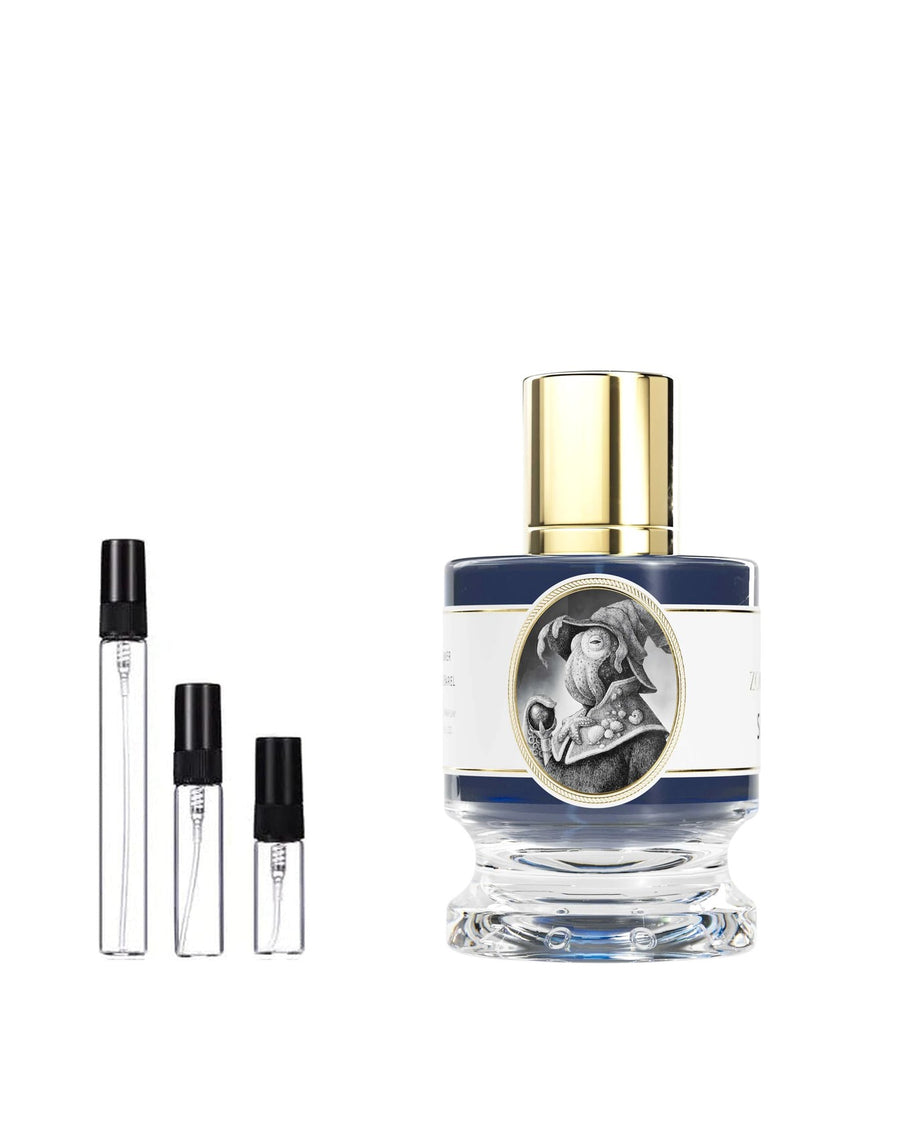
Squid (2019, Céline Barel) is the deep sea: pink pepper, solar salicylate and incense, then a black ink accord, a salty accord and opoponax, over ambergris, benzoin and musk.
Tyrannosaurus Rex (2018, Antonio Gardoni) is set in a scorched Cretaceous landscape: bergamot, black pepper and fir, then champaca and rose, over resins, cade, frankincense, leather and vanilla.

Camel (2017, Christian Carbonnel) is a caravan on a long road: dried fruits, palm date and rose, then amber, incense and myrrh, over oud, sandalwood, tonka bean and vanilla.

Moth (2018, Tomoo Inaba) follows an insect that cannot resist a flame: black pepper, cinnamon, clove and saffron, then heliotrope, iris and rose, over honey, guaiac wood, oud and smoke.

Hummingbird (2015, Shelley Waddington) is the lightest of the first six: apple, cherry, lilac and rose, then honeysuckle, mimosa and peony, over amber, moss, musks and sandalwood.

Cow (2022, Nathalie Feisthauer) is a green pasture: sage and apple, then milk, lily of the valley and heliotrope, over cedarwood, vetiver, benzoin and musks.

Harvest Mouse (2023, Luca Maffei) is harvest warmth: bergamot, clove and Roman chamomile, then davana, hay absolute and a beer extract, over fir balsam, oakmoss, Peru balsam and vanilla.

Two newer ones complete the ten. Rabbit (2024, Fanny Bal) is a night meadow of clover, carrot, hay and a biscuit accord, over patchouli, white almond and vanilla. Penguin (2024, Chiaki Nomura) is Antarctic air and an ice accord with juniper, saffron and sea moss, over sandalwood, musks and suede.
The Zoologist note map
Vanilla closes Bee, Tyrannosaurus Rex, Camel, Harvest Mouse and Rabbit, and rose runs through five of the eight. Incense links Squid, Tyrannosaurus Rex, Camel and Moth, oud links Camel and Moth, and sandalwood links Bee, Tyrannosaurus Rex, Camel and Hummingbird. Honey sweetens Bee, Moth and Hummingbird, and apple appears in Hummingbird, Cow and Rabbit. The oud samples guide places Camel and Moth among other houses.
A first order of Bee, Squid and Camel covers sweet, salty and spiced. Because these are strong extraits, wear one per day and read how to test perfume on skin. The darker ones suit winter.
From Zoologist sample to bottle
If one holds up over several wearings, the bottle is the next step. Our vial is filled by FragranceGems from the original bottle and labelled by us; Zoologist is not involved and it is not a brand sample. The first perfume in full size is at Zoologist Bee. The sample set page shows how to combine vials, and the FAQ covers filling and labels.
FAQ
Which Zoologist sample should I try first?
Bee. It has the most Parfumo ratings of the ten on our list, and its orange, ginger syrup and royal jelly accord over mimosa, heliotrope, benzoin and vanilla show the house at its most approachable.
Why does the brand recommend a sample first?
The brand calls its range creative, artistic and strong, not mass-appeal, and does not recommend buying a 60 ml bottle blind. A decant on your own skin is exactly the step it suggests.
Are Zoologist perfumes made with animal products?
The brand states that, apart from Bee (beeswax) and Hyrax, its perfumes are free of animal products, and that any animal musk or civet in an ingredient list is synthetic and marked with an asterisk.
